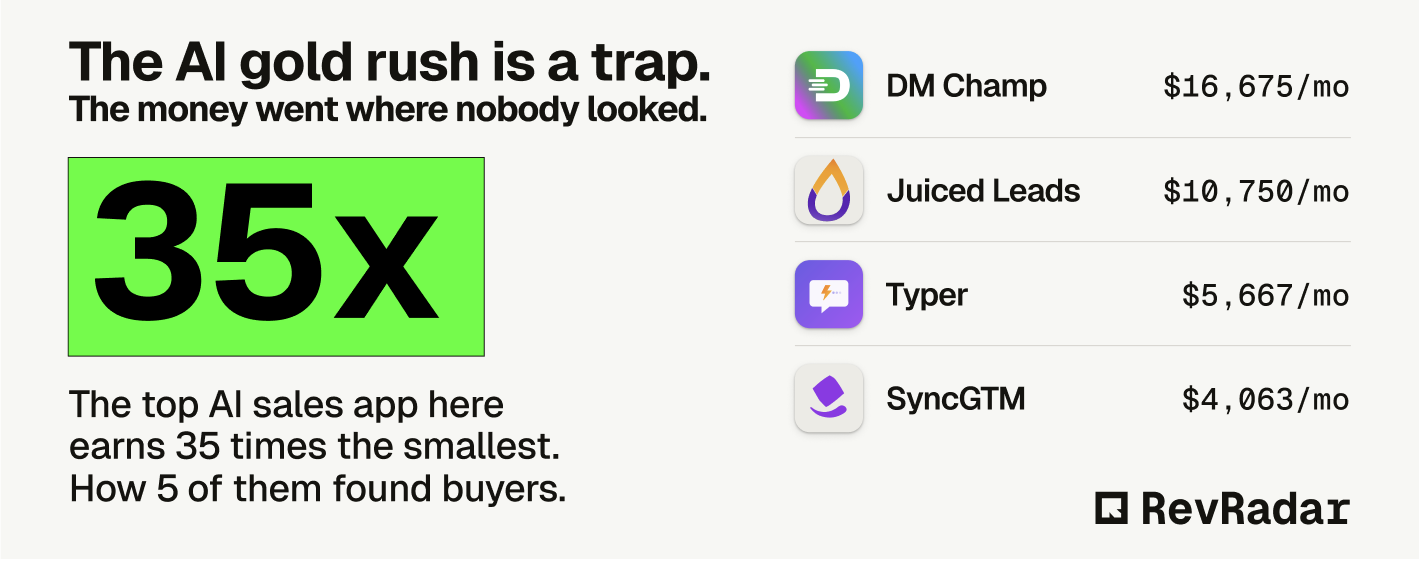
The AI gold rush is a trap. These 7 sales apps went where nobody was looking
No hype, just paying customers. Who built them, and how five of them found buyers, in the founders' own words.
Where the customers came from
Everyone's chasing the next viral AI app.
Seven of the ones getting paid sit in the least glamorous corner of tech: sales.
Here's how five of them found their first buyers.
In February 2026, Drew Carrell walked out from behind a curtain in front of 3,000 people. He had three phones in his pocket and no script. His team had been told about their stage slot about ten minutes earlier.
"I was super nervous," he said later on his podcast. "I'd never been on stage in front of 3,000 people before."
The plan was to have influencers call real leads live, on stage, while the room watched his software on the big screens. The first call rang out. So did the second. The third connected, and a deal was agreed within ten minutes. Then the team put up a QR code, and 625 people signed up in about five minutes.
That's one way to get customers. It isn't the only one. Sohaib Ahmad started with cold email to local clinics. Kushal Magar wrote comparison pages. Om Patel went to Product Hunt. Yuval Perez films his whole business on Instagram.
This piece is about those moments. I went through the 38 apps TrustMRR files under Sales and took the biggest real software app in each sales job. Then I went looking for the founders' own accounts of how the first paying customers showed up. By the end you'll know who built each of the seven, when they started, what they tried first, which channel worked, and where each one stands now.
Rules I used:
Revenue reported by TrustMRR. Every MRR and 30d figure is from the app's public TrustMRR page. TrustMRR pulls it from payment providers once a founder connects them.
Growth stories in the founders' own words, from interviews, podcasts, posts and their own sites, with a source for each. Any number in a founder quote is self-reported, not TrustMRR.
No guessing. Where nobody has told the story, I say "No public source found."
Snapshot dates: Nov 2, 2026. DM Champ, SyncGTM and dayonelead are as of Nov 4. "30d" means the change in MRR over the last 30 days.
I left out managed services and agencies, since a team doing the work for you isn't an app. I also left out apps whose money looks like one-off payments rather than subscriptions.
1. AI chat selling
The best salesperson for an AI sales app is the AI itself.
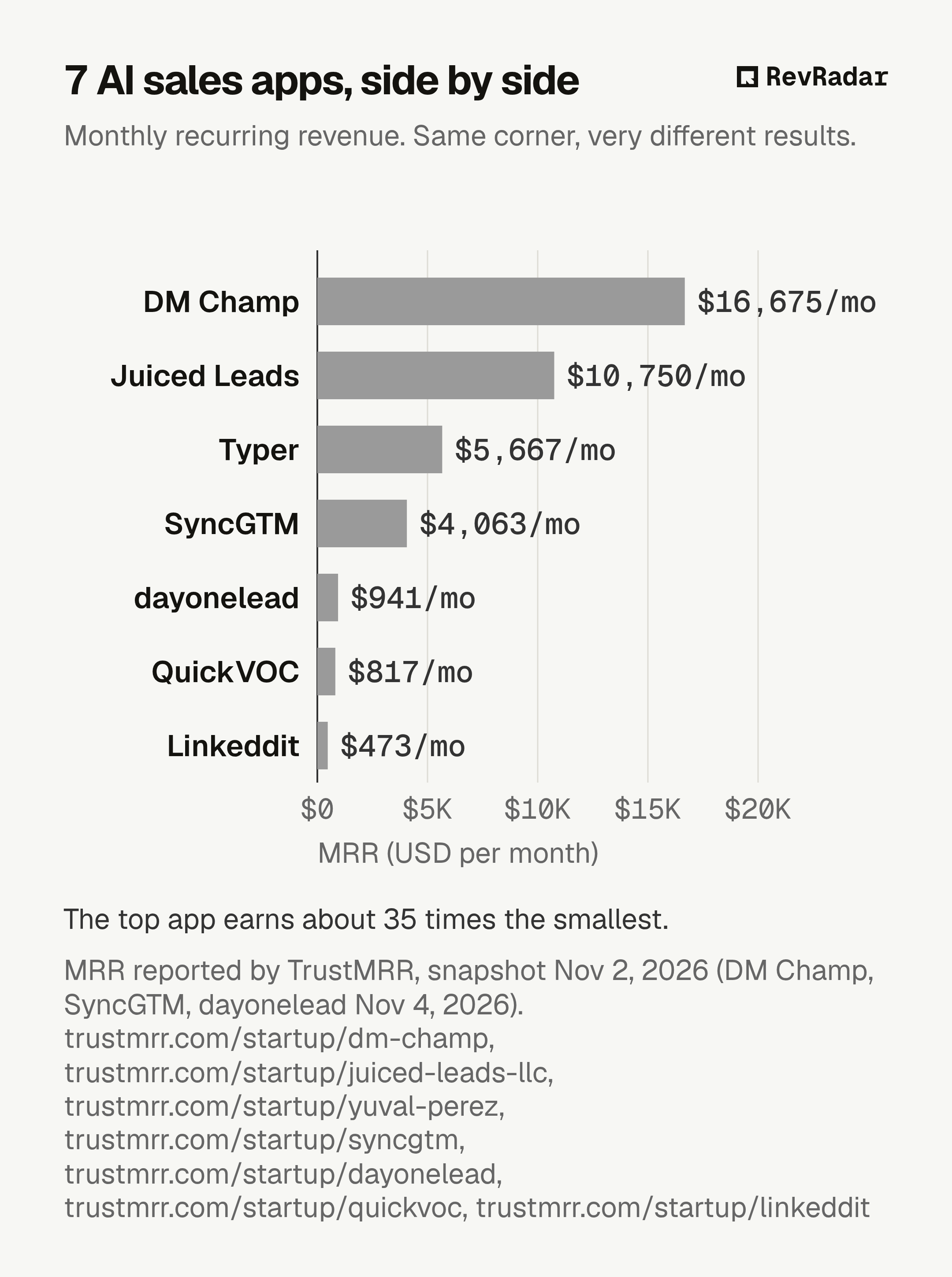
DM Champ · $16,675/mo
Sohaib Ahmad's first customer was a clinic with a spreadsheet.
He started DM Champ in January 2023, from The Hague. It's an AI sales agent that answers leads on WhatsApp, Instagram and web chat, and agencies can white-label it and resell it to their own clients.
The first sale came from cold email. "Our first sale came through cold email," he told Starter Story. "I targeted local clinics, got three interested, and only followed up with one. That clinic had less than 200 old leads sitting in a spreadsheet." His AI wrote to those old leads on WhatsApp, and he says it "generated €2K per month in recurring revenue" for the clinic. His offer was narrow: wake up the dead leads you already paid for. "If you have a product that delivers fast ROI, cold email still works," he said. "You just need a specific offer, not a generic pitch."
The next step went less well. DM Champ listed on AppSumo. "Made €20K, got 300 customers, but 40% refunded because we got the pricing wrong," he said. His lesson in his own words: "get your pricing structure right the first time, because platforms don't always give you a second chance."
The day that changed things came from someone else's audience. "One of our team members knew a business coach in the Netherlands with a big audience," he said. The coach ran a 60-minute webinar showing DM Champ to 300 people. "Within two minutes of the offer going live, we had $20K in Stripe. 80 customers." Sohaib wasn't a fan of the format. "I'm not a webinar person. It felt cringe to me. But the numbers don't lie."
Under all of it sits one habit. "We use DM Champ to sell DM Champ," he said. Prospects talk to the AI, and only later find out it was AI.
That habit carried into a second AppSumo run. The company's own playbook says it reached "700+ lifetime buyers" and $250K in revenue in the first 2.5 months, with a 4.9-star average across 184 reviews. That was a lifetime deal, so it's one-off money, not MRR, and the deal ended on August 14, 2026. The playbook names the channel it leaned on hardest: "the comment-to-DM funnel using DM Champ to promote DM Champ." Anyone who commented on the launch post got the deal link in their DMs from DM Champ's own AI.
The playbook is open about who it aimed at. "AppSumo's audience is huge, but most of them are not your buyer," it says. So the team posted on LinkedIn for agency owners, ran a Skool community called DM Champions, and made every piece of content about white label, sub-accounts and reselling. They built six tiers, from no sub-accounts up to unlimited, and most of the revenue came from the top two. "Two hundred buyers heavy in the top tiers produces more revenue than a thousand buyers all clustered at Plan 1," the playbook says. It also says the team "replied to every review, including the harsh ones, within a day."
Today the plans are Business at $97 a month, Agency at $297 and Agency Unlimited at $497 (dmchamp.com). MRR is $16,675. It isn't for sale.
Typer · $5,667/mo · +13.1% 30d
Typer is the youngest app in this piece. Yuval Perez started it in May 2026, and he does his marketing in public, on camera.
"I'm a software builder," his site says. "I run Typer AI from my laptop and I film the whole road on Instagram." His current series is what he calls the Hormozi Build: he takes plays from Alex Hormozi's $100M books, runs them on his own company, and posts what happened. "The wins, the misses, and the numbers." He even made a wheel of "179 business challenges" pulled from those books. He spins it and films the result.
The product sells the same way it's marketed. Typer is an AI setter that sits inside Instagram DMs. In his words, "It answers every message in your own voice within seconds, day and night. It qualifies the lead, gets the phone number, and books the sales call straight into your calendar." His site says it's "made for coaches and service businesses that get clients from Instagram."
So the channel and the customer are the same place. He films on Instagram, and the people watching are the people with busy Instagram inboxes. On Oct 22, Yuval (@yuvapreneur) posted: "Here's Typer, the AI behind all 102,980 of these DMs." The Typer site now says it's "trusted by 70+ creators and brands," with a live counter of DMs handled.
His personal site also has a scoreboard, titled "The Road to $100K MRR" (MRR is monthly recurring revenue). It says it shows Typer's real revenue, straight from the dashboard he runs the business from. "No screenshots, no rounding up."
That's an unusual amount of openness for a company this young, and it's worth crediting. Most founders share numbers after they're good. Yuval is sharing them on the way up. The site even explains the sales flow step by step: a DM comes in, Typer replies "in your voice," qualifies the lead, handles the objection, books the call, and pings the owner on WhatsApp when it needs a human. Typer says it connects "through Meta's official API" as a Meta Business Partner.
What we don't know: how many customers came from the reels versus anywhere else. He hasn't broken that down. Pricing isn't public either. The site books a demo rather than showing a price.
MRR is $5,667, up 13.1% in 30 days, about six months after it started. It isn't for sale.
2. CRM, lead routing and quotes
The fastest way to prove software works is to run your own company on it.
Juiced Leads · $10,750/mo · +10.3% 30d
The first customer for Juiced Leads was its own founders.
Drew Carrell (founder) and Nolan Nordlund (CTO), the roles LinkedIn gives, built Juiced in February 2024 for a pay-per-lead company called LeadZolo. LeadZolo sells real estate investors leads from people who want to sell their house for cash.
Juiced is lead distribution software. Buyers bid on fresh leads, leads nobody takes drop into a private marketplace at falling prices, and the leftovers can go into a monthly subscription pool. Billing runs from a wallet that buyers fund in advance.
The name came from the problem. "We very appropriately named our software Juiced," Drew said on That Agency Show, the podcast he co-hosts with Kyle Sulerud, "because being able to juice every drop out of your leads is what makes a PPL company profitable." On episode 11 (May 29, 2026), Kyle, the co-host, called Juiced "the software that we are using for our pay-per-lead company."
The bidding changed what LeadZolo could charge. They set a $200 minimum and a $1,000 cap, assuming nobody would get near it. "Lo and behold, we have clients bidding $1,000 per lead," Kyle said. Drew explained who those buyers are: "Phenomenal operators want more volume." The investors doing well, he said, care less about cost per lead and more about getting enough leads to grow.
They also split leads into types instead of throwing away the ones that didn't fit. Leads from houses already listed with a realtor used to be discarded. Kyle said: "When we first started the company, and for a long time, we really had nothing to do with these leads." Now those leads sell for as little as $1 to $20, and he says they bring in "about 4 to $5,000 per month." Mobile home and commercial leads added another $5,000 to $6,000 a month, by his count. By the time of the episode, LeadZolo had 14 lead types.
The marketplace turned waste into revenue. Leads with no bidder used to go almost nowhere. Now they sit on the marketplace for 24 hours and drop in price every hour. "It's added about $100,000 in revenue a month by introducing Marketplace," Drew said. Those are LeadZolo's numbers, self-reported, not Juiced's.
The Juiced site tells the same story as a case study: "Leadzolo sold 56% more of the same leads." It says 41.5% sold on the first pass and 64.9% sold in total.
And then there was the stage. The marketplace is what they showed in front of those 3,000 people in February. Before Juiced, Kyle said, LeadZolo had signed up "870 customers in two years." Then 625 people signed up in about five minutes, because, as Kyle put it, "people could see the product." Not all of them put money in, he added. Afterwards they changed the funnel: anyone can sign up and buy from the marketplace, but the bidding system needs a sales call and a minimum wallet deposit. Drew also made a 60-second ad of himself signing up on his phone, buying a lead and calling the seller.
So the customer story here has two layers. LeadZolo is the proof, and the podcast is how they reach new buyers. Every episode is two founders explaining, in detail, how their own lead company uses the software. Drew tells listeners how to sign up at usejuiced.com.
Plans start at $250 a month, with no per-lead fee and a 7-day free trial (usejuiced.com). MRR is $10,750, up 10.3% in 30 days. It isn't for sale.
3. Outbound automation
In outbound, the whole pitch is getting there first.
dayonelead · $941/mo
Matt is a solo founder, and his complaint is short: "most lead databases are stale."
He said it on Product Hunt, launching dayonelead on Sep 7, 2026. It finds businesses the day they register with the state, checks their contact details, and writes a cold email campaign that you approve before anything sends. He started it in April 2026.
His site makes the pitch against the big names directly: "Apollo and ZoomInfo charge thousands for businesses everyone has already cold-called." dayonelead covers Florida, New York, California, Colorado, Texas and Connecticut so far.
Where his paying customers came from: no public source found. The Product Hunt launch got 3 upvotes. The site shows two testimonials, including Colin Singleton of Conduit Systems: "DayOneLead is one of the first tools I recommend to clients without hesitation."
There's one plan: 14 days free, then $49 a month. It's the only eligible app in this job, and it's small. Not for sale.
4. Lead lists and data
Google still hands customers to the founder who shows up before the crowd.
SyncGTM · $4,063/mo
Kushal Magar got his customers from Google, and he wrote down exactly how.
He started SyncGTM in June 2025. It's AI data enrichment and sales workflows, and he pitches it as a cheaper Clay. Plans run from $49 to $649 a month.
His LinkedIn post from Oct 8, 2026 opens with the result: "Here's the exact Claude Code SEO/AEO setup that got SyncGTM to 3,700+ sign-ups and 9k monthly organic traffic under 6 months. It's just one man + Claude Code, without an agency or a content team."
He says the whole thing costs "~$130/month to run: $100 Claude Max, $20 VPS to host website, $9 SpyFu." The setup is plain. The site is built on Astro so that, in his words, "Claude can write, publish, and fix pages on its own." He also warns founders on Cloudflare to check that bot protection isn't blocking AI crawlers: "If ChatGPT and Perplexity can't read your pages, they can't cite you." For research he uses SpyFu to pull competitor pages that recently reached page one, then asks Claude for a two-month blog plan.
The keyword plan is the part most founders skip. "Go after low-volume, low-competition keywords," he wrote. "A new domain can rank for these, and they add up fast." The formats that worked best for him were "'X vs Y' comparisons and 'X alternatives' listicles, with your tool mentioned as an option." His reasoning: "People searching these are already shopping."
Then there's timing. When Claude Code launched, he wrote pages like "Claude for GTM engineers" and "Claude for RevOps" before anyone searched for them. "There was zero search volume," he said. "Today they rank top 3 for most of those keywords and bring in sign-ups." His explanation: "You publish before the demand exists, so Google has months to trust the page."
The writing itself runs on three agents he calls blog_planner, blog_writer and blog_manager. He says they publish "2–4 posts a day." For links, he says Claude submitted the site to about 700 free listing sites, and "SyncGTM reached DA 50 in 6 months without an agency."
His own role now, he says: "My only job now is to assist in kw planning once every 2 months."
Two cautions. Sign-ups aren't paying customers, and he doesn't say how many of the 3,700+ pay. And this is one post by the founder, not an audit.
MRR is $4,063. It's listed for sale on TrustMRR.
5. Voice and calls
Some of the apps getting paid have never told anyone how.
QuickVOC · $817/mo · +57.7% 30d
Konstantin Baturin started QuickVOC in December 2023. It's a CRM for HVAC, plumbing and other trades, with an AI receptionist that answers every call and books the job.
How it found its customers: no public source found.
Plans are $149, $299 and $549 a month, with a 3-day free trial and no card needed. MRR is still small. Not for sale.
6. Buying-intent monitoring
The strongest launch fuel can be people telling you it won't work.
Linkeddit · $473/mo · -23.8% 30d
Om Patel built Linkeddit to answer his critics.
He started it in July 2024. It finds people on Reddit who say they're ready to buy, or who match what you're looking for, and hands you a list. Plans are $49 and $99 a month.
The story starts with a different product. Om had built BigIdeasDB, a database of software problems pulled from negative reviews and job posts. When he shared it on Reddit, he says, "the response was brutal." He lists the replies: "Why would anyone pay for this?" and "This won't make me money."
"Instead of arguing, I decided to prove them wrong," he wrote in his newsletter. "I built a product using my own database." That product was Linkeddit. The BigIdeasDB research behind it, he says, came from "150,000+ negative reviews from 8,000+ companies on G2 and 5,000 job postings on Upwork."
He then used Linkeddit on himself, to find people on Reddit who could critique his landing page. His newsletter lists what followed: "First sale in 30 minutes after implementing their feedback," "First-place ranking on Product Hunt," and "Over $4000 in revenue within 2 weeks."
The launch was in February 2025. On Feb 24 he posted that Linkeddit "just finished first place" on Product Hunt. In the same post: "3 weeks ago, this product was nothing but an idea on BigIdeasDB."
So the channel was a sequence: a database, a Reddit argument, a Product Hunt day.
That was early 2025. MRR now is $473, down 23.8% in 30 days. It's listed for sale on TrustMRR.
Patterns
1. Trust is borrowed before it's earned. Most of these founders sold through a crowd that already trusted someone. DM Champ's best day was a coach's webinar. Juiced's was a sponsor slot at someone else's event. Typer's is Yuval's own Instagram following.
2. The product is the pitch. Two of them use the product to sell the product. DM Champ answers its own prospects with its own AI. Juiced showed its live marketplace on stage, with real leads being bought on the screens.
3. In search, early wins over loud. Search still works if you're early. SyncGTM wrote pages for searches that didn't exist yet, and says they now rank top 3.
4. Your own company is your first case study. Being your own first customer gives you a story to tell. Juiced has a podcast full of LeadZolo numbers, because LeadZolo runs on it.
5. A bad first channel is a pricing lesson. DM Champ's first AppSumo run brought 300 customers and a 40% refund rate. Sohaib's takeaway was about pricing, not about AppSumo.
6. A launch day is a spike, not a business. A first place on Product Hunt lasts one day. The apps that last kept selling after it.
7. Silence is part of the story. Two stories aren't public yet. dayonelead and QuickVOC haven't said where their paying customers came from. Outbound is also the thinnest job here: dayonelead is the only eligible app in it.
8. The gap nobody in this corner is building for. Cold email runs through this piece: DM Champ's first sale came from it, and dayonelead writes cold email campaigns. Yet none of the 38 apps TrustMRR files under Sales keep cold email out of spam (Nov 2).
What the seven stories add up to
The gold rush sells hype. These founders sold proof.
Go back to Drew Carrell walking out on that stage. His 625 sign-ups didn't come from an ad. They came from a room full of people who watched the product work in front of them.
Most of the stories here have that in them. Sohaib's clinic saw its own dead leads come back. The coach's audience watched a demo and bought within two minutes. Kushal's readers were already comparing tools when they found his pages. Om's first buyers came straight after a Product Hunt day. Yuval films the product while it runs.
If there's one takeaway, it's this: the founders who could explain how they got customers all had one channel where people saw the product working before they paid. Where that story is missing, so is the public answer to how they grew.
About the numbers
MRR and 30d change are reported by TrustMRR, as of Nov 2, 2026 (DM Champ, SyncGTM and dayonelead as of Nov 4). I haven't checked them any other way.
Founder quotes, and any numbers inside them (sign-ups, webinar sales, LeadZolo revenue, AppSumo results), are self-reported and come from the sources named in each section.
These numbers will be out of date within weeks. Check the live pages.
So, which of these channels would you try first: a cold email with one narrow offer, a webinar on someone else's audience, a live demo in front of a crowd, comparison pages, or filming the whole road?
I track where AI apps actually get paid while everyone else chases the rush. Follow so you catch the next one.