How 8 AI Chatbots Make Money: Revenue, Plans, Caps and API Prices
Who says how much comes in, what each one charges, what you get before it cuts you off, and what the API costs.
Kimi charges $19 to $199 a month. Then, on Oct 25, it had to say sorry for "rate limits and unnecessary quota consumption" on its K3.1 Pro plan, and it gave every subscriber on every plan 25% of their monthly quota back. "One week of usage," Moonshot says.
We're sorry for the rate limits and unnecessary quota consumption on the K3.1 Pro subscription plan. These were our issues, and we should have fixed them sooner.
Today, every subscriber on every plan gets a one-time usage reset, restoring 25% of their monthly quota (usage below 25% resets to zero), equal to one week of usage. Your usage bar will reflect this adjustment by end of day PST.
We've also adjusted the plan's parameters and are reducing unnecessary subagent calls and output length, so your quota goes further.
Thank you for your patience while we put this right.
That made me curious about the other seven. A chatbot subscription looks simple: pay a monthly fee, chat. But the real product is the cap, and every company draws it differently.
So I read the pricing pages and help docs of 8 AI chatbots. I wanted the boring details: what each plan costs, how usage is limited, what the API charges per token, and whether the company says what it earns.
Who makes what
The money first.
Anthropic, the company behind Claude, made $16.8 billion in revenue in Q3 2026, up from $4.7 billion in Q1, CNBC reported on Oct 15. Those are quarters, not a run rate. That's one report.
OpenAI, which makes ChatGPT, "told investors that it hit roughly $50 billion in annualized revenue at the end of September," CNBC reported on Oct 8. Annualized means a recent stretch scaled up to a year, for the whole company.
Perplexity went from under $250 million in annualized revenue at the start of the year to more than $750 million, per The Information, as carried by Reuters on Aug 23. That's one report.
DeepSeek is at an annualized run rate of about $1 billion, more than double a few months earlier, per The Information, as carried by Reuters on Sep 24. That's one report.
Gemini, Grok and Kimi don't say. Mistral's CEO gave only a forecast: annual recurring revenue expected to exceed $1 billion in 2026 (CNBC, Sep 8).
These are different measures from different dates: quarterly revenue for Anthropic, annualized figures for the other three. So don't line them up against each other. Next: where the money comes from, then how each one charges: plans, caps and API prices.
Where the money comes from
Revenue is one number. This is what's behind it. Each company splits it differently, if it says at all, and the measures differ, so read each line on its own.
ChatGPT (OpenAI): consumer plans, business and enterprise plans, a usage-based API, and now ads. OpenAI says ChatGPT ads hit a $1 billion annualized run rate (Aug 31, 2026). CFO Sarah Friar told investors most revenue now comes from enterprise, CNBC reported (Aug 14, 2026), citing someone who was there. That's one report.
Claude (Anthropic): of nearly $4.6 billion in 2025 revenue, about $3.8 billion came from customers paying by usage and $789 million from subscriptions, per Anthropic's IPO filing as reported by Reuters (Sep 29, 2026). That's one report. Anthropic says Claude "will remain ad-free" (Feb 4, 2026).
DeepSeek: the paid product is a per-token API. DeepSeek doesn't disclose a split.
Gemini (Google): Google AI plans sold under Google One with storage and YouTube Premium perks, a paid Gemini API, and Gemini Enterprise. Google doesn't break out Gemini revenue.
Grok (xAI): SuperGrok plans and the Grok API. SpaceX reports Grok inside a bigger segment that also holds X ads, X subscriptions, data licensing, cloud deals and Cursor, and doesn't split Grok out (SEC filing, Oct 20, 2026).
Kimi (Moonshot AI): paid memberships and an API. The API brings in more than 70% of Kimi's revenue, according to people close to the company (NBD, Jun 30, 2026; also TheInsight, Aug 10, 2026). Both reports likely trace back to the same sources.
Mistral Le Chat (Mistral AI): Le Chat Pro, Team and Enterprise plans plus an API, and a mobile carrier offers Pro to its subscribers. CEO Arthur Mensch told Axios enterprise is "95% of our businesses" (Axios House, Davos, Jan 22, 2026). That's one statement, and he didn't say 95% of what.
Perplexity: "mainly" consumer subscriptions, WIRED reported (Feb 19, 2026), citing executives it didn't name, after Perplexity dropped plans for ads. It also sells Enterprise seats at $40 or $325 per user per month and says 50,000+ organizations trust Perplexity Enterprise (Perplexity Enterprise page, Oct 26, 2026).
Three put a percentage or a dollar split on it: Anthropic's filing (via Reuters), Kimi (via anonymous sources) and Mistral's CEO. OpenAI's CFO and Perplexity (via WIRED) gave a direction. DeepSeek, Gemini and Grok don't say.
Rules I used:
Prices from the live pricing pages, read from Europe on Oct 26, 2026. Each price is in the currency the site showed me. Some show euros, some show dollars.
Caps come from the companies' own pages: pricing pages, help centres and plan docs. If a company only says "abuse guardrails" or "limits apply", I say that.
Revenue only if the company said it, or a named outlet reported it, with the date. Otherwise it says "not disclosed." A run rate is not the same as a year of revenue, so each cell says which one it is.
No guessing. If I couldn't find something, I say so.
8 chatbots, in alphabetical order. I didn't rank them. The prices come in two currencies, and the plans don't buy the same thing.
The 8 at a glance
Plan prices are in the currency each site showed me from Europe, so a euro price and a dollar price can't be compared directly. API prices are all in US dollars.
Plans and caps
Chatbot
Paid plans, monthly
Free tier
Usage cap
ChatGPT
Go €8, Plus €23, Pro from €103
Yes, text chats "subject to abuse guardrails"
Abuse guardrails, plus tool limits
Claude
Pro €18, Max from €90
Yes, "Free for everyone"
5-hour sessions, plus weekly limits on paid plans
DeepSeek
No consumer price shown
Not shown when logged out
Not found
Gemini
AI Plus €4,99, AI Pro €21,99, AI Ultra from €99,99
Yes, "standard limits"
5-hour refresh, plus a weekly limit
Grok
Plus €8, Premium €31, Super €105, Ultra €210 (after intro prices)
$0 tier on x.ai
Weekly pool shared with Cursor
Kimi
$19 to $199
Adagio, $0
Monthly quota
Mistral Le Chat
Pro $14.99, Team $24.99 per user
Yes, "Limited messages and web searches"
Limited messages on Free
Perplexity
Pro $17, Max $167 (billed yearly)
Yes, "a few" advanced searches a day
Monthly credits on Max
API and money
Chatbot
Top-model API, $ in / out per 1M tokens
Revenue or run rate
ChatGPT
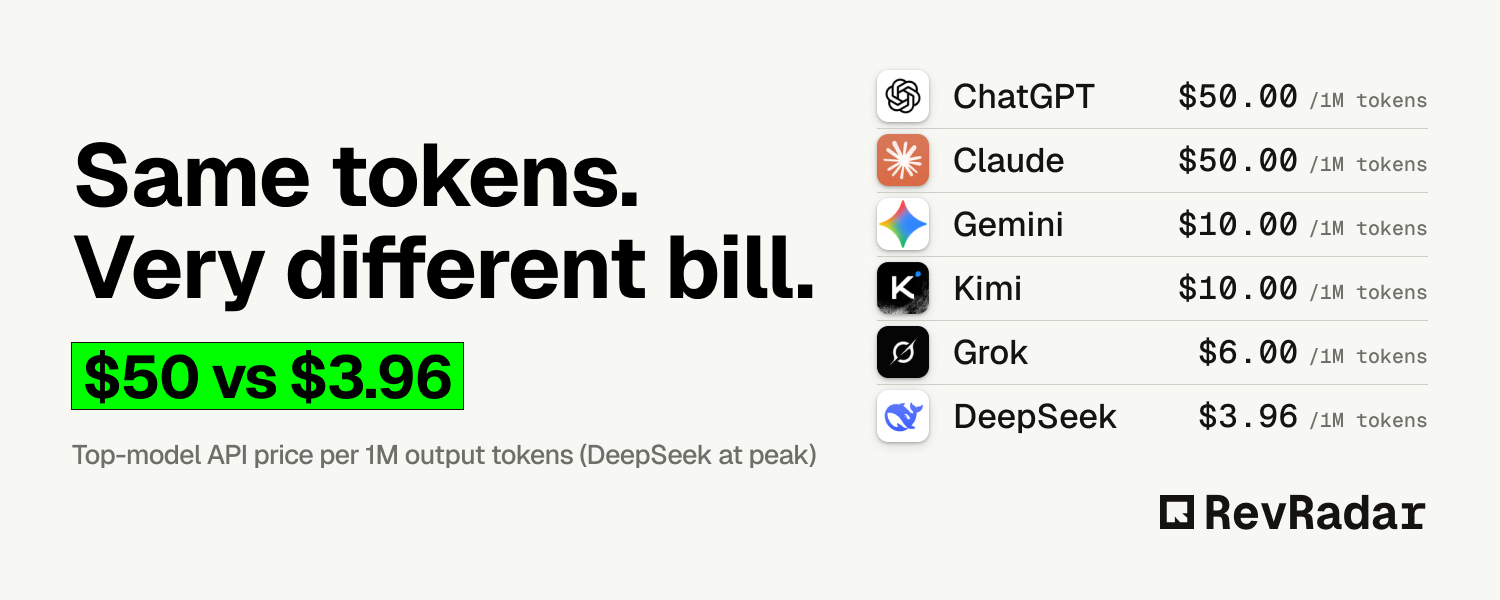
gpt-6-astra: $10 / $50 (short context)
About $50B annualized, end of September (CNBC, Oct 8)
Claude
Claude Fable 5.1: $10 / $50
$16.8B in Q3 (CNBC, Oct 15)
DeepSeek
deepseek-v4-pro: $1.32 / $3.96 at peak, $0.66 / $1.98 off-peak
About $1B run rate, per The Information (Sep 24)
Gemini
gemini-4-argon: $2 / $10 through Nov 30; $4 / $20 from Dec 1
Not disclosed
Grok
grok-4.7: $2 / $6 (under 200K context)
Not disclosed
Kimi
kimi-k3.1-pro: $2 / $10
Not disclosed
Mistral Le Chat
Not disclosed
Not disclosed
Perplexity
Perplexity's own search model (sonar): $0.25 / $2.50
Over $750M annualized, per The Information (Aug 23)
1. ChatGPT (OpenAI)
Plans: Go €8, Plus €23 and Pro "from €103" a month. Pro comes in "3 usage tiers", and their prices aren't shown when you're logged out. The Go card says: "This plan may include ads." Free: €0. The card says "Unlimited text chats subject to abuse guardrails." The Go card says exactly the same thing. Caps: OpenAI's help page: "Free and Go users have unlimited everyday text chats, subject to abuse-prevention safeguards. Separate limits continue to apply to file uploads, image generation, voice, data analysis, and other tools." Plus just says "Limits apply." On Pro: "A Pro subscription does not include unlimited use of the GPT-6 Pro model." And in general: "Your allowance does not correspond to a fixed number of messages or tasks." For Work and Codex (not Chat), OpenAI estimates 5 to 45 GPT-6 Astra messages per five-hour window on Plus, and adds: "These ranges are estimates, not guaranteed message counts." API: gpt-6-astra costs $10 in and $50 out per 1M tokens. That's the short-context price, up to 272K tokens. Longer context costs more ($20 / $75). Money: OpenAI "told investors that it hit roughly $50 billion in annualized revenue at the end of September," CNBC reported on Oct 8. That's an annualized figure for the whole company, not a year of ChatGPT revenue. Ads are part of it now: "Ads may appear for users on the Free and Go plans," and "ChatGPT Ads supports impression and valid-click billing." Last 90 days: A delayed Astra launch came with usage resets: banked resets on Sep 3 and Sep 4, and an automatic reset on Sep 7. OpenAI's words: "The daily reset offers covered the broader Astra launch delay." On the API side, "Priority processing was renamed Fast mode on July 30, 2026."
2. Claude (Anthropic)
Plans: Pro is €18 a month billed monthly, or €15 a month billed yearly (€180 up front). Max is "from €90" a month, with "5x or 20x more usage than Pro". The two Max prices aren't shown when you're logged out. The page says: "Prices shown don't include applicable tax." Free: €0, "Free for everyone." Caps: "Every plan has usage limits that reset on a rolling five-hour session window, and paid plans add weekly limits on top." Pro gives "at least 5x more usage per 5-hour session than Free", and Max gives "5x or 20x more usage per 5-hour session than Pro." Anthropic also says it "may limit your usage in other ways, such as weekly and monthly caps or model and feature usage, at our discretion." API: Claude Fable 5.1 costs $10 in and $50 out per 1M tokens. Money: $16.8 billion in revenue in Q3 2026, up from $4.7 billion in Q1, CNBC reported on Oct 15. That's one report. On ads, Anthropic wrote in February: "Claude will remain ad-free." Last 90 days: Anthropic cancelled a planned API price rise. Sonnet 5's "$2/$10 per million input/output token pricing", launched as an introductory price, "is now the standard price." The increase to $3/$15 scheduled for September 1, 2026 "will not occur."
3. DeepSeek
Plans: No consumer price is shown on DeepSeek's site when you're logged out. Free: Not shown. The chat sends you to a sign-in page, so I couldn't see what's included. Caps: I didn't find an official page on consumer usage limits. API: deepseek-v4-pro costs $1.32 in and $3.96 out per 1M tokens at peak, and half that off-peak: $0.66 in and $1.98 out. DeepSeek only lists peak and off-peak prices. There's no "standard" price. "Peak hours are 01:00 - 04:00 and 06:00 - 10:00 UTC, Monday through Friday, excluding Chinese public holidays." Money: An annualized revenue run rate of about $1 billion, more than double a few months earlier, per The Information, as carried by Reuters on Sep 24. That's one report. Last 90 days: Server-side tool calls "are currently free of charge; per-request billing starts at 00:00 Beijing time on November 1, 2026."
4. Gemini (Google)
Plans: Google AI Plus is €4,99 a month, Google AI Pro €21,99 and Google AI Ultra "from €99,99". Ultra comes in two tiers, €99.99 and €219.99 a month. (The local page writes the same price with a comma in one place and a dot in another.) Free: €0, with "standard limits." Caps: Google describes "compute-based usage limits" and says: "Your limit refreshes every 5 hours until you reach your weekly limit." AI Plus gets 2x the standard limits, AI Pro 4x, and AI Ultra "5x or 20x higher than AI Pro limits depending on your subscription." When paying users hit the limit, they "can continue your conversation with Flash-Lite." And: "Limits may change without notice, including due to capacity constraints." API: gemini-4-argon, which Google calls "Our flagship reasoning model", costs $2 in and $10 out per 1M tokens through Nov 30, 2026. From Dec 1, it's $4 in and $20 out. Money: Not disclosed. Alphabet doesn't report Gemini revenue on its own. What it does say: the Gemini app has 950 million monthly active users (Q2 2026 results, Jul 22). Last 90 days: Google's API pricing page (last updated Oct 22) shows the Gemini 4 Argon price doubling on Dec 1. gemini-3.8-flash goes from $0.75 / $3.75 to $1.50 / $7.50 from Jan 1, 2027.
5. Grok (xAI)
Plans: Plus is €8 a month. Premium is €16 for the first month, then €31. Super is €53, then €105. Ultra is €105, then €210. Billed yearly: €80, €310, €1,050 and €2,100 a year. Prices are shown before tax. Free: x.ai/pricing lists a $0 Free tier. Caps: "Every tier includes a pool of AI usage shared across Grok and Cursor." The allowance "refreshes weekly". Premium gets 4x the usage of Plus, Super 15x and Ultra 50x. "If you reach your included usage, you can keep going with top-ups, or wait for your allowance to refresh." API: grok-4.7 costs $2 in and $6 out per 1M tokens, under 200K tokens of context. Above that it's $4 / $12. Money: Not disclosed. Last 90 days: I found no dated pricing change. SpaceX's filing says it completed its acquisition of Cursor on Aug 14, 2026.
6. Kimi (Moonshot)
Plans: Plus $19, Pro $39, Max $99 and Ultra $199 a month. Billed yearly, they work out to $15, $31, $79 and $159 a month. Free: Adagio, $0. Caps: A monthly quota. Kimi doesn't publish the quota in absolute numbers. It lists agent credits relative to each other: Plus gets "more agent credits", Pro 2x, Max 5x and Ultra 10x. API: kimi-k3.1-pro costs $2 in and $10 out per 1M tokens, on Moonshot's own pricing page. "Prices exclude applicable taxes." Money: Not disclosed. Last 90 days: the apology. Moonshot said sorry for "rate limits and unnecessary quota consumption" on the K3.1 Pro plan, and every subscriber on every plan got 25% of their monthly quota back, "one week of usage." Its own words: "These were our issues, and we should have fixed them sooner." Most companies don't write that sentence.
7. Mistral Le Chat (Mistral AI)
Plans: Pro is $14.99 a month and Team $24.99 per user a month, both "Excluding taxes". Pro includes "$25.5 /mo in API credits." Enterprise is "Contact us". Free: Yes: "Limited messages and web searches. Limited coding sessions." Caps: That free-tier line is the only limit wording I found. No numbers. API: Not disclosed. I couldn't find a dated price page for Mistral's top model, so I left it out. Money: Not disclosed. In a CNBC interview (Sep 8), Mistral's CEO said annual recurring revenue is expected to exceed $1 billion in 2026. That's a forecast, not a figure. Last 90 days: No pricing change found. Mistral raised €3 billion in a round led by Samsung (CNBC, Sep 8).
8. Perplexity
Plans: Pro is $17 a month and Max $167 a month, both "when billed annually". Max includes "10,000 monthly credits". The monthly-billed prices aren't shown on the page. Free: "The free plan limits advanced searches to a few per day and locks you to a single default model." Caps: The free-plan line above, and Max's monthly credits. I couldn't open the help centre page with the detailed limits. API: Perplexity's own search model (sonar) costs $0.25 in and $2.50 out per 1M tokens. It's a search model, not a top model like the others in this list. Perplexity's API mostly resells other companies' models at their list price, gpt-6-astra included, at $10 / $50. Money: Annualized revenue of more than $750 million, up from under $250 million at the start of the year, per The Information, as carried by Reuters on Aug 23. That's one report, and "Perplexity declined to comment." Last 90 days: Nothing I could confirm from a Perplexity source.
Patterns and lessons
1. The price is half the plan. The cap is the other half. Every one of them draws the line differently: rolling 5-hour windows with weekly limits on top (Claude, Gemini), a weekly pool (Grok), a monthly quota (Kimi), monthly credits (Perplexity Max), and "abuse guardrails" (ChatGPT). Most don't publish exact numbers. You only learn which kind you bought when you hit it.
2. "Unlimited" comes with a footnote. ChatGPT's Free and Go cards both say "Unlimited text chats subject to abuse guardrails." Pro says "Unlimited subject to abuse guardrails." The help page then says a Pro subscription "does not include unlimited use of the GPT-6 Pro model."
3. Plans ladder up fast. Kimi goes from $19 to $199 a month. Grok goes from €8 to €210 once the intro price ends. The top plans aren't for chatting more. They're for people who run heavy work through them all day.
4. The API gap is wide. ChatGPT's top model (at short context) and Claude's both cost $50 per 1M output tokens. DeepSeek's costs $3.96 at peak, so $50 is 12.6x as much. Off-peak, DeepSeek charges $1.98, and the gap is 25.3x. Different models, different strengths, so this is list price only. But it's the same unit and the same currency.
5. Half of them don't say what they make. For Gemini, Grok, Kimi and Mistral, revenue is not disclosed. The other four numbers come from press reports (CNBC or The Information). Prices are public. Money mostly isn't.
6. Changing the cap is changing the price. In the last 90 days Kimi handed back 25% of a month's quota (Oct 25), and OpenAI offered Astra usage resets on three days in September. On the API side, Google's Dec 1 change doubles Gemini 4 Argon's price, and DeepSeek starts billing tool calls on Nov 1. If you sell anything with a usage limit, your users read the limit as part of what they paid for.
About the numbers
Consumer prices come from each company's live pricing page, read from Europe on Oct 26, 2026. They're in the currency the site showed: euros for ChatGPT, Claude, Gemini and Grok, dollars for Kimi, Mistral and Perplexity. DeepSeek showed no consumer price. I didn't convert anything, so don't compare a euro price with a dollar price.
Tax: Claude, Grok and Mistral say their prices exclude tax. I didn't find a tax note on the ChatGPT, Gemini, Kimi or Perplexity plan pages I read.
API prices are official US dollar list prices per 1M tokens, as of Oct 26, 2026, for the top model on each company's own pricing page. Where a price depends on context length, time of day or date, I say which one. Perplexity's row is its own search model, not a top model. API and chat subscriptions are different products, so an API price tells you nothing about what a chat plan costs.
Revenue is company-stated or from a named report with its date. "Annualized" and "run rate" mean a recent period scaled up to a year, not a year of actual revenue. OpenAI's and Anthropic's figures are for the whole company. Figures from different dates and definitions aren't apples to apples.
Caps are described in each company's own words. Most don't publish exact numbers, and some say they can change them without notice.
"Last 90 days" covers Jul 28 to Oct 26, 2026.
Anything I couldn't source is marked "not disclosed" or "not found."
These numbers will be out of date within weeks. Check the live pages.
Every price and limit in this post is on a public page somewhere, but scattered across 8 sites, two currencies and a lot of footnotes. I build AI tools fast, and the part I keep getting wrong isn't the model. It's the plan: what to charge, and where to draw the line.