323 Small Apps For Sale: What the Asking Prices Say
Speel.co asks 0.64x its yearly MRR. On the cash it actually collected, that same price is 14.7x.
Like a lot of people, I can build an app. The hard part is knowing which one. So before I make anything, I do what a sensible shop owner does first: walk the market, see who's selling what, what's flying off the shelves, what's gathering dust, and where there's a gap nobody has filled yet.
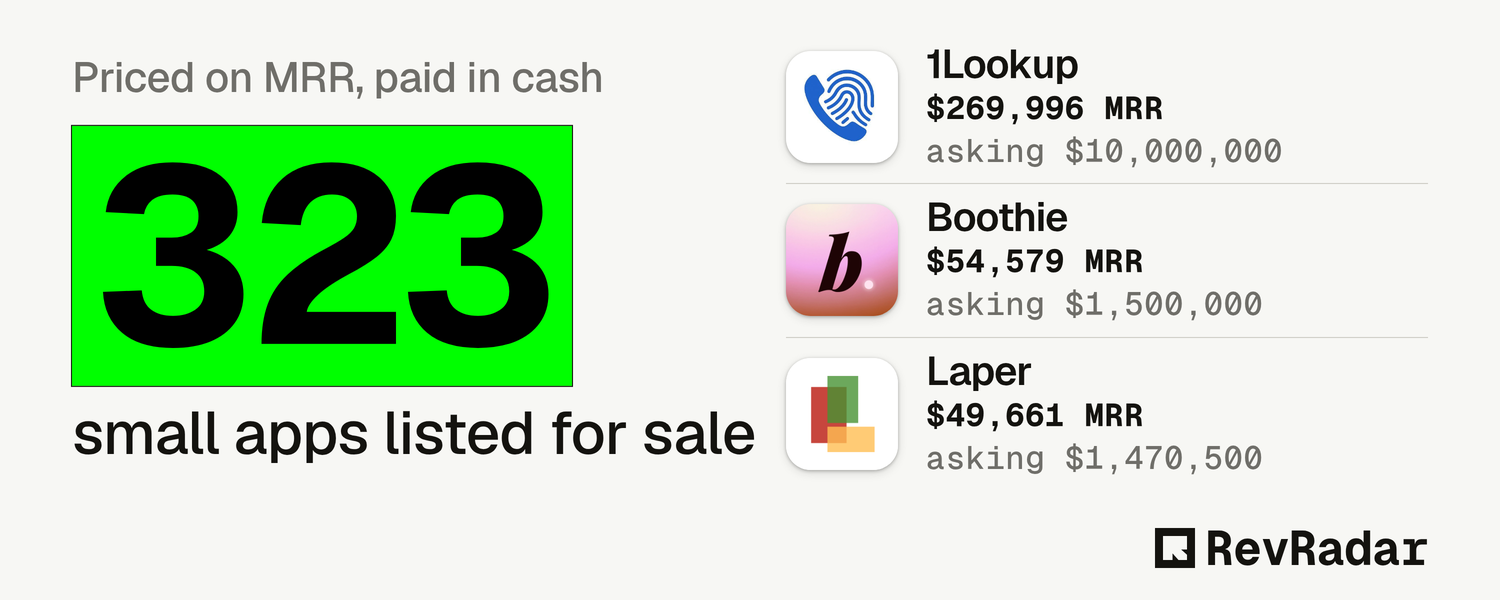
I went through 323 apps for sale this week to see what else the price tags hide.
By the end you'll know what the ten biggest apps on the market are, how to tell whether an asking price is fair, why MRR and cash can disagree, and the one question to ask a seller before anything else.
1. Priced on MRR, paid in cash
The two multiples, side by side Where they disagree
The way this works is that every app for sale shows two money numbers. They sound like the same thing. They're not.
MRR means monthly recurring revenue: what all the app's subscriptions add up to each month, on paper. A made-up example: a gym with 100 members on a $50 plan has $5,000 MRR, even if a few cards bounce.
Cash is the money that actually landed in the bank over the last 30 days. Bounced cards and refunds pull it below MRR. Yearly plans paid up front can push it way above.
Why care? Sellers usually price on MRR. But whoever buys the app lives on the cash. (Nobody has ever paid rent with a subscription that's on paper.) When the two don't match, part of the price may be for money that never shows up.
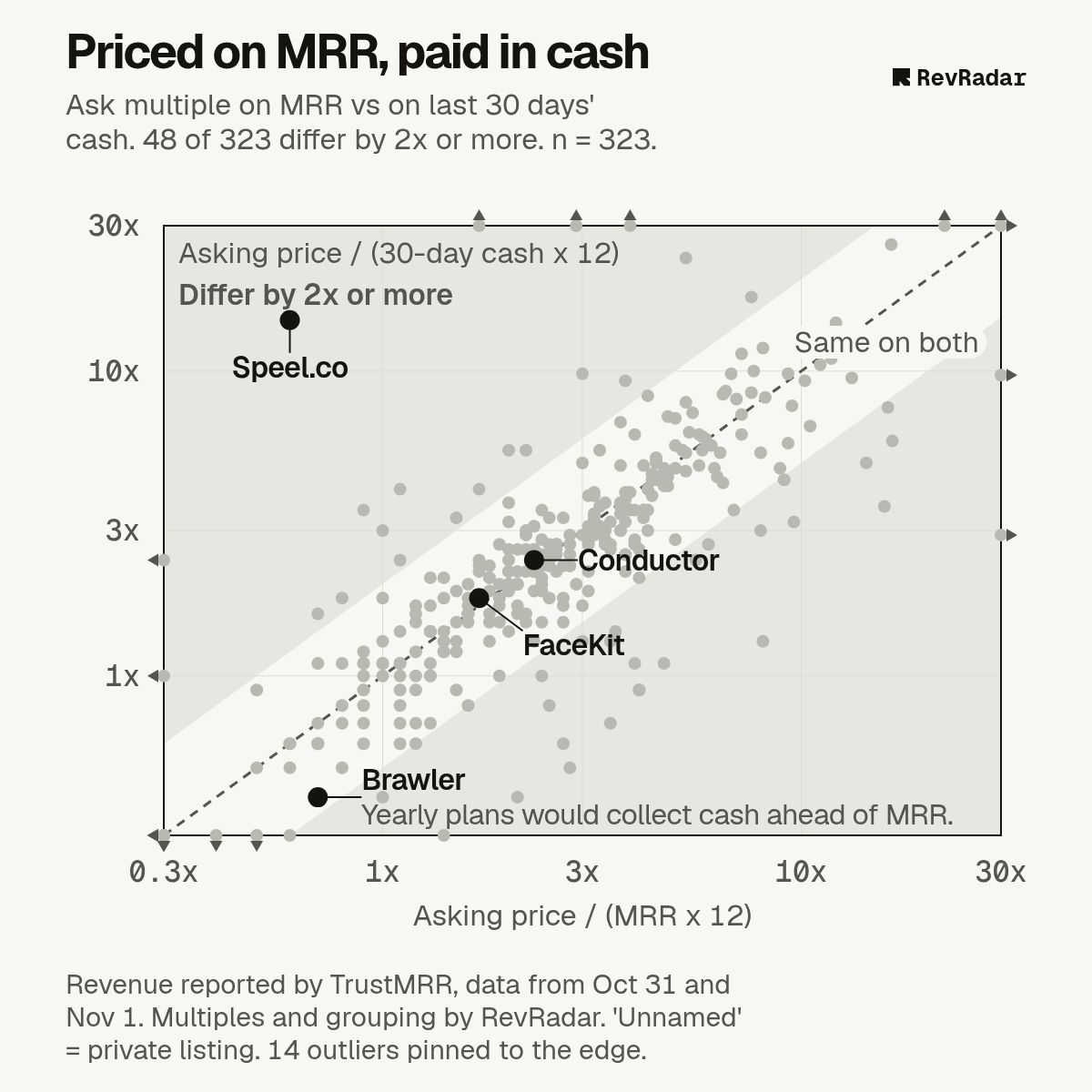
Most of the time they roughly agree. For 48 of the 323, one is at least twice the other.
Speel.co shows $65,342 in MRR. Over the last 30 days to Nov 1, $2,826 came in.
It's listed at $500,000. That's 0.64x its yearly MRR, and 14.7x its yearly cash (Nov 1). Same price, two very different bargains.
Its listing shows no revenue from January to September. So the buyer is paying for a promise that the MRR turns into money.
Brawler is the mirror image. Over the last 30 days to Nov 1, it took in $44,843, about twice its $23,459 MRR.
Its listing shows yearly plans. My guess: customers paid for the year up front, so the bank had a good month.
For 20 apps, the cash was under half the MRR. The scoreboard says one thing, the bank account says another.
For a buyer: when the two numbers disagree, ask the seller why before you ask the price.
2. Below the median, still growing
Growth vs asking multiple Four corners, one median
Think of a used-car lot. Find the car priced in the middle. A cheaper car that still starts every morning is the one people quietly drive home.
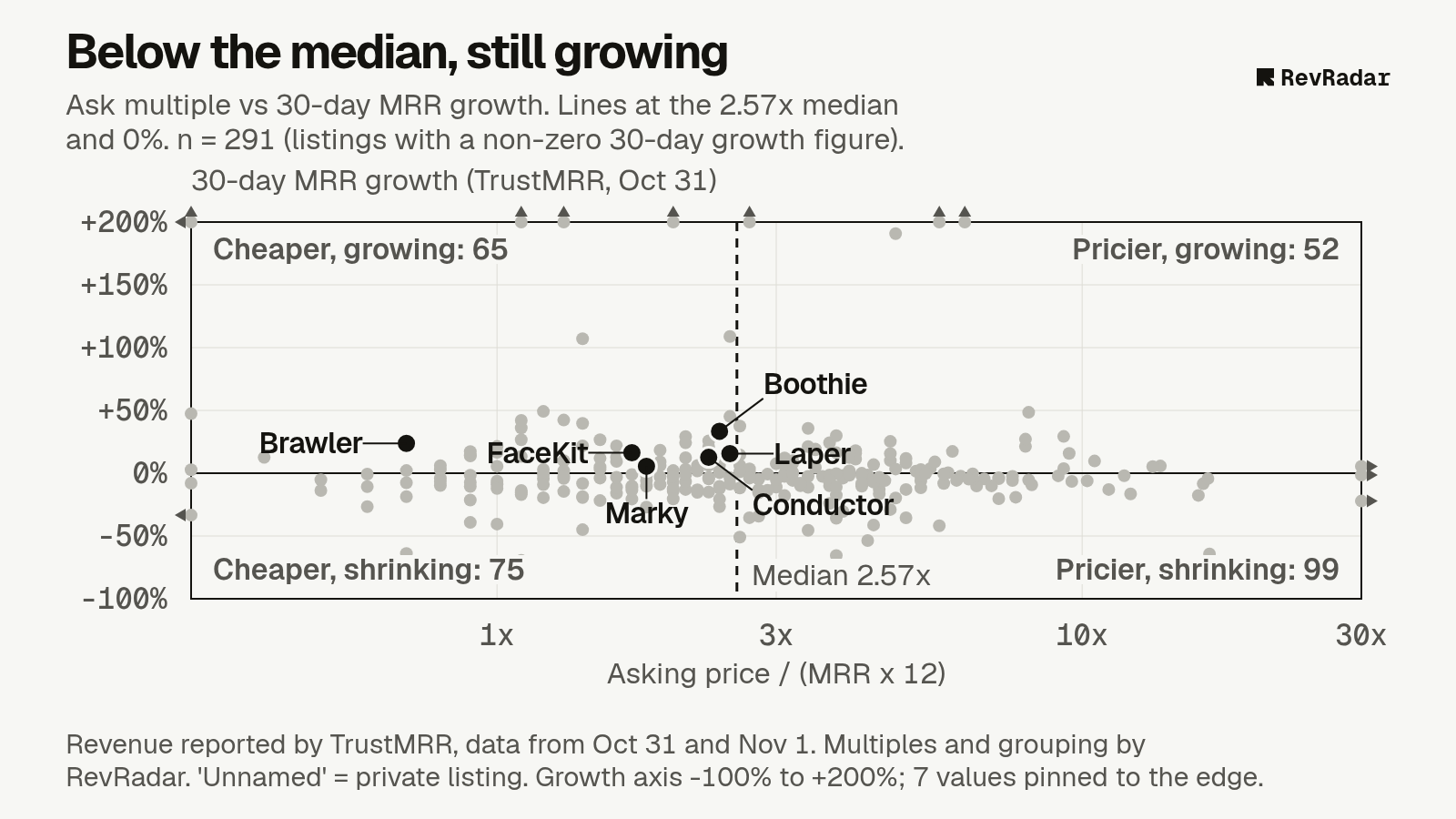
Apps work the same way. The middle asking price is 2.57x a year of MRR. In plain words, each price is measured against a year of on-paper revenue. Half the apps ask more, half ask less.
Now sort by growth. Of the 291 apps with a 30-day growth figure (as of Oct 31), 65 are cheaper than the middle and still growing.
The most crowded corner is the opposite one: pricier and shrinking, with 99 apps. The part nobody says out loud: much of the lot is shiny cars losing parts, priced like they're still growing.
Six named apps with MRR of $20K or more sit in the good corner: Brawler, FaceKit by @rafkramer, Marky by @josiah_coad, Conductor by @dannynemer, Boothie by @keremcanseker_ and Laper by @chunxiangai.
All six grew MRR by 6% to 33% over 30 days (as of Oct 31). They report margins of 50% to 95%.
They're listed at 0.71x to 2.48x a year of MRR, all under the middle. Boothie is the big ticket at $1,500,000.
At the far end sits LocalRank.so. It asks 7.70x its MRR, the highest of the apps we feature, and 10.0x its cash (Nov 1).
Its cash over the last 30 days to Nov 1 is down 36%. A high price for a shrinking till.
For a buyer: cheap and growing exists, but it's the small corner, not the whole room.
3. After margins, the order changes
Same price, different take-home Margins as the sellers report them
Revenue isn't profit. Picture two lemonade stands that each sell $10 of lemonade (a made-up example). One spends $1 on lemons and sugar. The other spends $9. Same sales, very different afternoon.
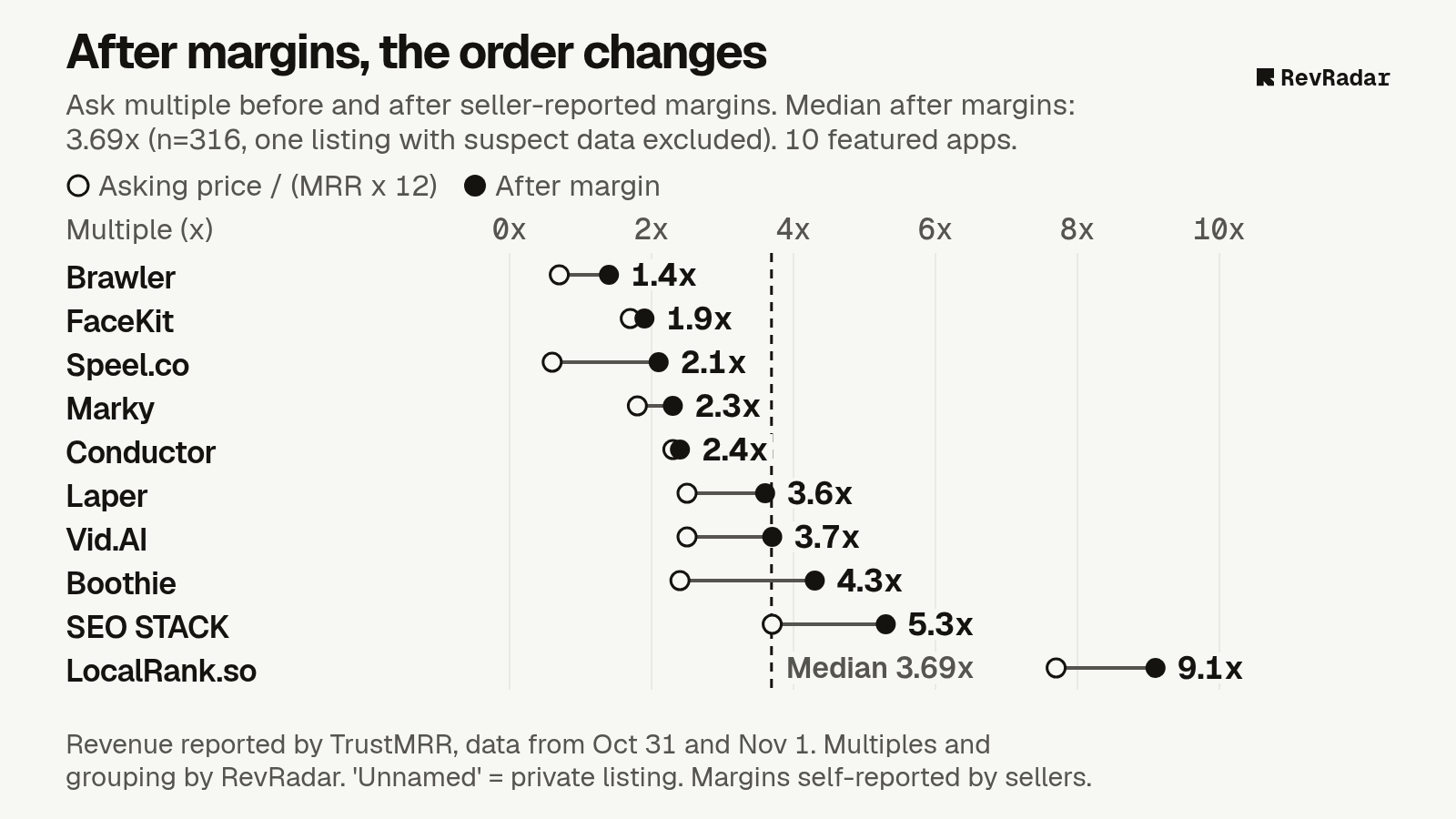
Margin is the share of each sale you keep. Here's the trick: I took each asking price and compared it with a year of MRR times the margin the seller reports. The ranking moves.
Conductor reports a 95% margin. It barely moves, to 2.40x.
Speel.co reports 30%. Its 0.64x more than triples, to 2.13x.
The middle app after margins is 3.69x (316 apps that list a margin, one with suspect data left out). Remember, sellers fill in their own margins.
For a buyer: a cheap price on thin margins is a different animal from the same price at 90%.
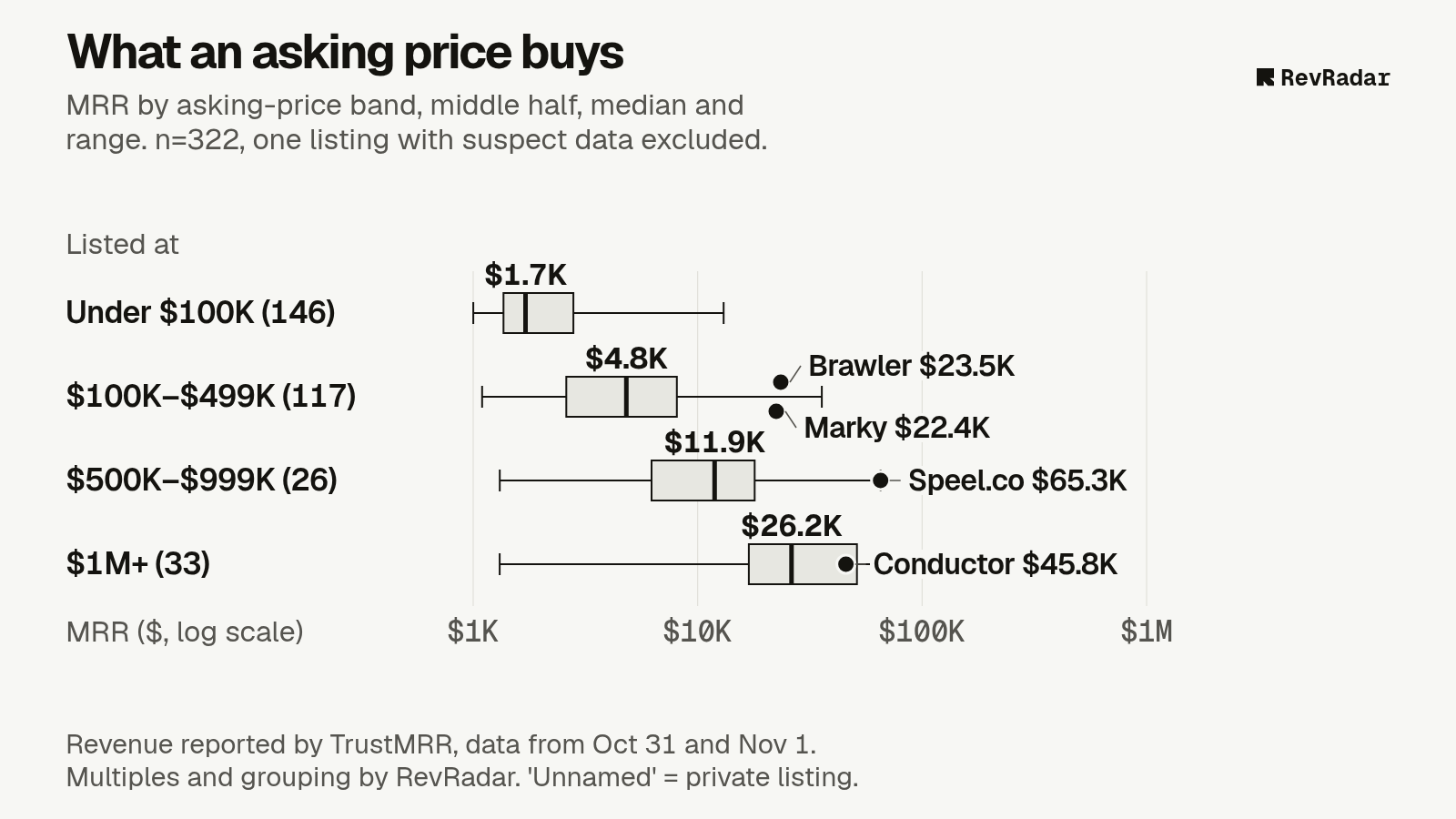
4. What an asking price buys
The price ladder MRR by asking-price band
Under $100K: 146 listings, with the middle one at $1.7K MRR
$100K to $499K: 117 listings, middle at $4.8K
$500K to $999K: 26 listings, middle at $11.9K
$1M and up: 33 listings, middle at $26.2K
Source: revenue reported by TrustMRR, Oct 31 pull, sync checked Nov 1. Grouping and multiples by RevRadar. 322 listings, one with suspect data left out.
Think of apartments. A pricier flat usually has more rooms. Each price step up here buys more monthly revenue.
Mostly, you get what you pay for. The middle $1M+ app shows $26.2K MRR.
That's about 15 times the $1.7K of the middle app under $100K (322 listings, one with suspect data left out).
Then there's Brawler. Listed at $200,000, it shows $23.5K MRR, close to what the million-dollar crowd brings. The big flat at a small-flat rent.
For a builder: if you plan to sell one day, MRR is the number the price follows.
5. What's on the market right now
The ten biggest sellers, by MRR
Picture an estate agent's window, only the houses are apps. These are the ten biggest listings by MRR, grouped by what they do. Figures are reported by TrustMRR (Oct 31). The multiple is the asking price divided by a year of MRR.
The first thing you notice: some of the houses have no street name. 3 of the 10 biggest sellers won't say who they are. (You can apparently buy a house without being told where it is.)
Two apps dropped off this list when we rechecked it today. One is no longer listed for sale. The other has numbers we don't trust, so it stays out, the same way it does everywhere else in this issue.
Mobile apps
Boothie: AI Photo Editor by @keremcanseker_, ranked 8: $54,579 MRR (Nov 2), asking $1,500,000, which is 2.29x. You upload a selfie and it comes back in a look: digicam, film, photobooth. The seller says it launched in June with no paid ads and grew through TikTok persona accounts.
Business software
1Lookup by @robbyfrank, ranked 1: $269,996 MRR, asking $10,000,000, which is 3.09x. It checks phone numbers, emails and IP addresses in real time for call centres, agencies and online shops. It was founded in 2022. Monthly revenue went from $187K last December to $509K in October, more than double in under a year. (It sells pay-as-you-go credits, which is how monthly revenue can run well ahead of MRR.)
Speel.co, ranked 5, asking $500,000. You've met it already: the 0.64x app whose cash didn't show up. It makes AI videos and images in the style of customer-made ads, and the seller says it went from zero to $1M a year in 3 months.
Education
Unnamed app, ranked 2: $154,393 MRR, asking $7,500,000, which is 4.05x.
Health and fitness
Unnamed fitness app, ranked 3: $104,426 MRR, asking $3,000,000, which is 2.39x.
GoTall, ranked 7: $56,624 MRR, asking $1,000,000, which is 1.47x. It's an iPhone app for tracking your height and building habits for growing taller, founded in July 2025. It grew through app store search, TikTok, Instagram and paid ads. Monthly revenue peaked at $148K in January. By October it was $26.5K. (Yes, that's another one where the month's revenue sits below the MRR. You know the drill by now.) The listing says the cofounders are separating.
Entertainment
Project A, ranked 6: $62,208 MRR (Nov 1), asking $5,000,000, which is 6.70x. It's an AI fortune-telling app with tarot cards and coffee-cup readings. The listing claims 50M+ downloads, and it grows on Meta, Google and TikTok ads. Monthly revenue has sat between about $82K and $102K since last December. The seller says there's extra ad revenue that isn't connected to TrustMRR. That's the priciest multiple in the top ten, and part of the case for it is revenue nobody can see.
AI creative tools
Laper by @chunxiangai, ranked 9: $49,661 MRR (Nov 1), asking $1,470,500, which is 2.47x. It's a workspace for screenwriters, directors and storyboard artists, built by a small bootstrapped team and founded in September 2025. Monthly revenue stayed under $1.4K until April. By October it was $53,656. (Pocket money to a proper salary in six months.)
Vid.AI, ranked 10: $49,342 MRR (Nov 1), asking $1,500,000, which is 2.53x. It turns scripts into ready-to-post AI videos for creators, at $39 to $199 a month, founded in September 2024. It grows through Meta ads and influencers. Monthly revenue sat around $82K to $90K from December to May. By October it was $39.6K.
Not labelled
Unnamed app, ranked 4: $66,047 MRR, asking $1,200,000, which is 1.51x.
The window has one more surprise. Speel.co and Project A show about the same MRR. One asks $500,000, the other $5,000,000. Mostly the price follows MRR, but near the top it also follows how much the buyer believes the story.
6. What moved this week
Price changes listed Oct 27 to 31 New listings, and single price events
A few sellers changed their price tags this week. These are single moves, not a trend.
Lyro now listed at $10K, previously $50K (change seen Oct 31) SyncGTM now listed at $90K, previously $120K (change seen Oct 31) LinkPost now listed at $79K, previously $99K (change seen Oct 31) Unnamed app 1 (private listing) now listed at $54K, previously $67K (change seen Oct 31) Unnamed app 2 (private listing) now listed at $26K, previously $32K (change seen Oct 31) Adly now listed at $155K, previously $125K (change seen Oct 31) ShopTok now listed at $78K, previously $63K (change seen Oct 31)
Three newcomers showed up too.
Store Stock Checker is listed at $135,000 with $22,197 MRR. It was founded Oct 23, so it has about 9 days of revenue. Too young to compare with the rest.
Stud Finder Wall Detector Tool is listed at $130,000 with $5,280 MRR. Its monthly revenue fell from $15.8K in December to $5.3K in October, with one rise in March.
Unnamed app 3 (private listing) is listed at $135,000 with $16,866 MRR. It launched in August, and its MRR is down 65% over the last 30 days to Nov 1.
What this tells us
An asking price is mostly a story about MRR. But nobody lives on MRR. You live on the cash that lands in the bank, and on the part of it you get to keep. So the first question for any seller is simple: how much cash actually came in? If the answer matches the MRR, at least the price tag starts from real money.
The price follows the promise, the bank follows the cash.
How we did this
Source: TrustMRR public listing pages, data as of Oct 31 UTC Ask multiple = asking price / (MRR x 12). Cash multiple = asking price / (last 30 days' revenue x 12). Growth is the 30-day MRR change. Margins are self-reported by sellers. Listings with no payments in 30 days, services and dropped apps are left out. Price changes cover Oct 27 to 31 and are single events, not a trend.
Excluded: 7 listings with no payments in 30 days, 3 services, and 1 dropped on recheck. "Unnamed" means a private listing. Asking prices aren't sale prices.
Your turn
Brawler, FaceKit, Marky, Conductor, Boothie, Laper or Speel.co: if you had to buy one at the price it's listed at, which one, and why?